
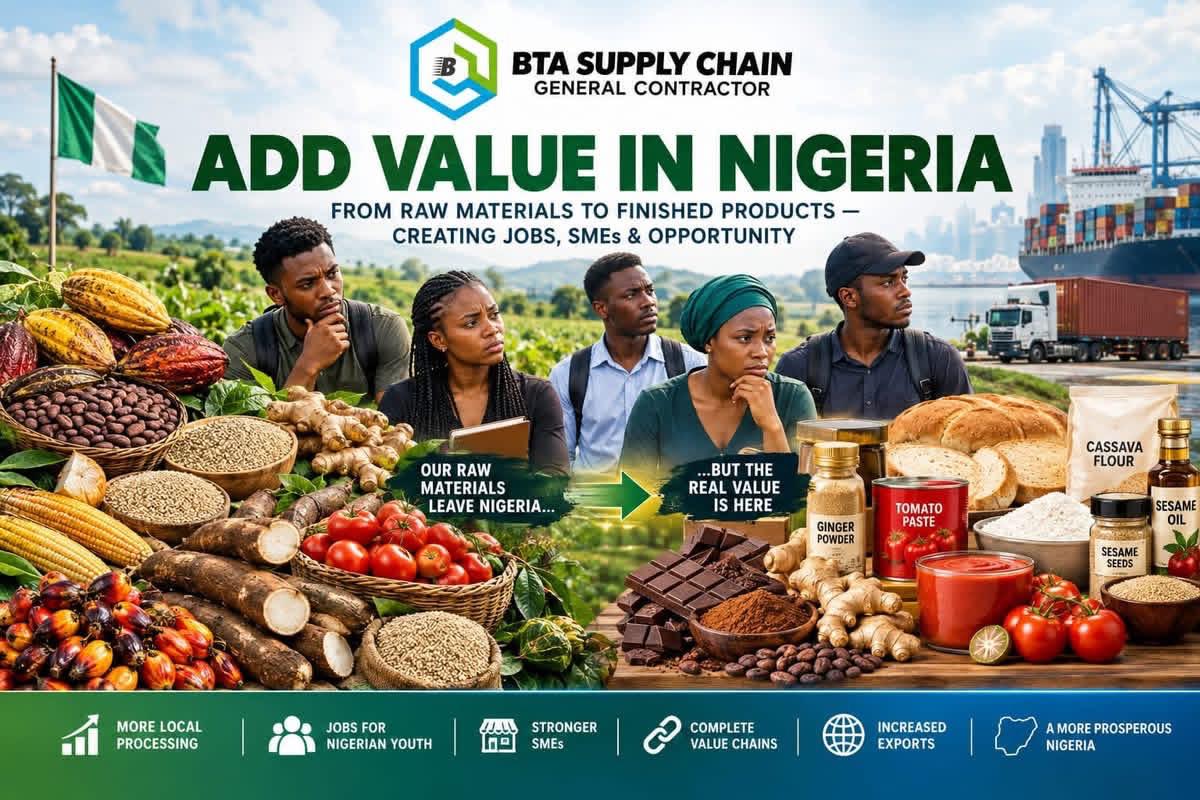
VALUE CHAINS
From Raw Materials to Finished Products: Why Nigeria Must Build Its Value Chains at Home
Nigeria has abundant agricultural resources, a large population, a growing consumer market, and millions of young people seeking meaningful economic opportunities. Yet, one of the country’s persistent economic challenges is that too many of its raw materials leave Nigeria with limited processing and return as higher-value finished products.
This pattern represents a significant missed opportunity.
Nigeria should increasingly encourage and support small and medium-sized enterprises (SMEs) to process locally produced raw materials into finished and semi-finished products before they are exported or sold to consumers. The objective should not simply be to produce more agricultural commodities, but to build complete value chains within Nigeria—from farming and aggregation to processing, packaging, transportation, marketing and export.
The transformation of raw materials into finished products can create businesses at every stage of the supply chain, generate employment for young Nigerians, increase household incomes, strengthen rural economies and reduce the country’s dependence on imported manufactured goods.
From Raw Materials to Value
Consider some of the agricultural products Nigeria already produces in significant quantities.
Sesame seeds can become tahini, sesame oil, snacks and other food products. Ginger can be cleaned, dried and processed into ginger powder, tea, extracts and other ingredients for domestic and international markets. Cassava can be transformed into high-quality flour, starch, industrial ethanol, animal feed and other products, while locally produced cassava flour can also contribute to bakery products.
Tomatoes provide another clear example. Instead of allowing large quantities of tomatoes to be lost because of inadequate storage and processing capacity, SMEs can transform them into tomato paste, canned tomatoes, sauces and other shelf-stable products.
Cocoa offers perhaps one of the clearest examples of the opportunity.
Nigeria is a major producer of cocoa beans, but the greatest economic value is not necessarily found in the raw bean. Cocoa can be processed into cocoa liquor, cocoa butter, cocoa powder, chocolate, beverages, confectionery and other consumer products. Each additional stage of processing creates opportunities for businesses, workers, logistics providers, packaging companies, distributors and exporters.
The question Nigeria should therefore ask is not simply:
“How much can we produce and export?”
It should also be:
“How much value can we create before the product leaves Nigeria?”
SMEs Can Become the Engine of Local Processing
Large industrial companies have an important role to play, but Nigeria cannot rely exclusively on large corporations to transform its agricultural economy.
SMEs can fill thousands of niches across the value chain.
One company may specialize in drying ginger. Another may grind and package ginger powder. Another may manufacture food-grade packaging. A third may distribute the product. Another may export it. This creates an ecosystem in which one agricultural commodity supports numerous businesses rather than generating income primarily for the farmer and the initial commodity trader.
This is how value chains create economic opportunities.
A young Nigerian entrepreneur does not necessarily need to own a large factory to participate. There are opportunities in aggregation, transportation, cold storage, drying, milling, processing, quality control, packaging, branding, digital marketing, equipment maintenance, distribution and export services.
The development of these interconnected businesses can turn agriculture from a predominantly primary-production activity into a broader manufacturing and industrial ecosystem.
Creating Jobs Beyond the Farm
Nigeria’s large youth population presents both a challenge and an opportunity.
Agriculture and agro-processing can provide employment not only for farmers but also for technicians, engineers, accountants, food scientists, designers, marketers, software developers, logistics operators, machine operators and entrepreneurs.
For example, a tomato-processing cluster could require:
- Tomato farmers and aggregators
- Transporters
- Cold-storage operators
- Processing workers
- Equipment technicians
- Packaging manufacturers
- Quality-control specialists
- Accountants and business managers
- Sales representatives
- Digital marketers
- Distributors and retailers
One agricultural commodity can therefore support an entire network of economic activity.
The same principle applies to cocoa, sesame, ginger, cassava, maize, rice, fruits, vegetables, shea nuts and many other Nigerian agricultural products.
Reducing Post-Harvest Losses
Local processing can also address one of agriculture’s major challenges: post-harvest losses.
Fresh agricultural products are often highly perishable. Where adequate storage, transportation and processing infrastructure are unavailable, farmers can be forced to sell quickly, sometimes at very low prices.
Processing creates another option.
Tomatoes can be converted into paste or canned products. Fruits can become juice, concentrates, dried fruit or other processed foods. Ginger can be dried and powdered. Cassava can be converted into flour and starch.
Processing extends shelf life and allows agricultural products to be sold beyond the immediate harvest period.
This can potentially give farmers access to more stable markets while creating opportunities for processors and other businesses.
Building an SME Manufacturing Ecosystem
For Nigeria to make this transition successfully, however, simply telling SMEs to “process locally” will not be enough.
The business environment must support them.
Government and financial institutions should consider mechanisms that make it easier for SMEs to acquire appropriate processing equipment, access affordable financing, obtain reliable electricity, meet food and export standards, and reach domestic and international markets.
Industrial clusters could be developed around major agricultural production areas.
A cocoa-producing region, for example, could support clusters containing cocoa aggregation centers, fermentation and drying facilities, processing plants, packaging businesses, warehouses, testing laboratories and logistics companies.
Similarly, ginger-producing communities could develop processing hubs where farmers bring their harvest for cleaning, drying, grinding, packaging and distribution.
Such clusters can reduce the cost of infrastructure and allow multiple SMEs to share services and facilities.
The Importance of Standards and Quality
Moving up the value chain also requires Nigeria to take product quality seriously.
If Nigerian SMEs want their products to compete internationally, they must meet appropriate standards for food safety, packaging, labeling, traceability and consistency.
The objective should be to move from simply exporting commodities to developing trusted Nigerian brands.
Imagine Nigerian chocolate brands competing in international markets, Nigerian ginger products appearing on supermarket shelves across Africa and beyond, Nigerian tomato products serving regional markets, and Nigerian cassava-based food ingredients being purchased by international manufacturers.
That is a very different economic model from exporting primarily unprocessed commodities.
A New Approach to Agricultural Exports
Nigeria does not need to stop exporting raw materials overnight. There will always be markets for commodities, and raw-material exports can remain part of the economy.
The strategic opportunity is to progressively increase the proportion of products that are processed domestically.
This can be achieved through incentives that make local processing commercially attractive, rather than simply imposing restrictions on raw-material exports.
For example, policies could support:
- Tax incentives for local agro-processors
- Affordable financing for processing equipment
- Shared processing facilities for SMEs
- Reliable electricity for industrial clusters
- Better rural roads and logistics
- Modern storage and cold-chain infrastructure
- Technical training for young entrepreneurs
- Research and development in food processing
- Improved access to export certification
- Stronger connections between farmers and processors
- Support for Nigerian brands entering international markets
The goal should be to create an environment where processing locally is not only desirable but also economically viable.
Turning Nigeria’s Agricultural Diversity into Industrial Opportunity
Nigeria has an extraordinary variety of agricultural raw materials.
The opportunity extends far beyond cocoa, cassava, ginger, tomatoes and sesame.
There are opportunities in rice, maize, sorghum, millet, groundnuts, palm products, shea, fruits, vegetables, spices, livestock products and numerous other commodities.
Each commodity can support multiple layers of economic activity.
A farmer produces the crop.
An aggregator collects it.
A processor transforms it.
A packaging company packages it.
A logistics company transports it.
A distributor takes it to market.
A marketing company builds the brand.
An exporter takes it to international consumers.
A retailer sells the finished product.
This is the value-chain economy Nigeria should seek to build.
From “Made in Nigeria” to “Value Created in Nigeria”
The conversation about local production should go beyond assembling imported components or encouraging Nigerians to buy Nigerian products.
Nigeria should pursue a deeper objective:
Value created in Nigeria.
That means encouraging domestic businesses to participate in as many stages of production as economically practical.
A Nigerian cocoa farmer should not only be connected to the international commodity market; there should also be Nigerian businesses buying, processing, packaging and branding cocoa.
A ginger farmer should have access to processors that can transform ginger into commercially valuable products.
A cassava farmer should be connected to processors producing flour, starch and other industrial inputs.
A tomato farmer should have access to processing facilities that can turn a perishable harvest into products with longer shelf lives.
This model creates opportunities far beyond farming.
Youth Entrepreneurship Can Be Built Around Existing Resources
Nigeria’s youth unemployment challenge is often discussed in terms of creating jobs. But there is another important question:
How can we create businesses that create jobs?
Agro-processing provides one answer.
Instead of viewing young Nigerians only as job seekers, policy can support them as entrepreneurs within agricultural value chains.
A young person could operate a small drying facility, establish a spice-processing business, manufacture packaging, provide logistics services, develop an agricultural marketplace, run a cold-storage business or build a consumer brand around locally sourced products.
With appropriate training, financing and infrastructure, thousands of such businesses could emerge.
The Long-Term Economic Opportunity
The transformation from a raw-material economy to a value-added economy will not happen overnight. It requires investment, infrastructure, skills, technology, financing, policy consistency and access to markets.
But the principle is straightforward:
The more stages of production Nigeria can perform competitively at home, the more economic activity can take place within Nigeria.
More processing can mean more businesses.
More businesses can mean more jobs.
More jobs can mean higher household incomes.
More local manufacturing can mean stronger domestic supply chains.
And stronger supply chains can create products capable of competing in regional and global markets.
Nigeria has spent decades demonstrating that it can produce agricultural commodities. The next stage should be demonstrating that it can transform those commodities into globally competitive products.
The future opportunity is not simply to export Nigeria’s resources.
It is to add value to those resources, build businesses around them, create employment from them and export the value-added products to the world.
That is how agriculture can become a stronger foundation for manufacturing, entrepreneurship, youth employment and sustainable economic development.
Nigeria should not only ask how much it can produce. It should ask how much value it can create from what it already produces.